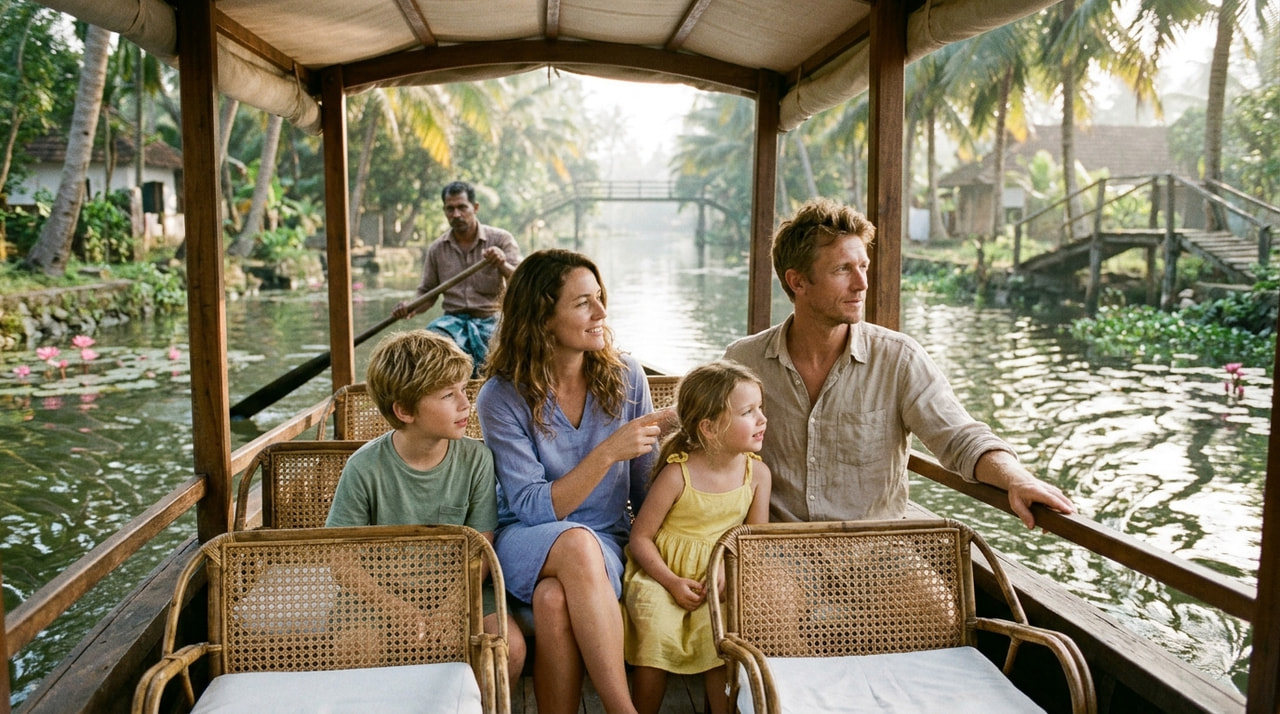
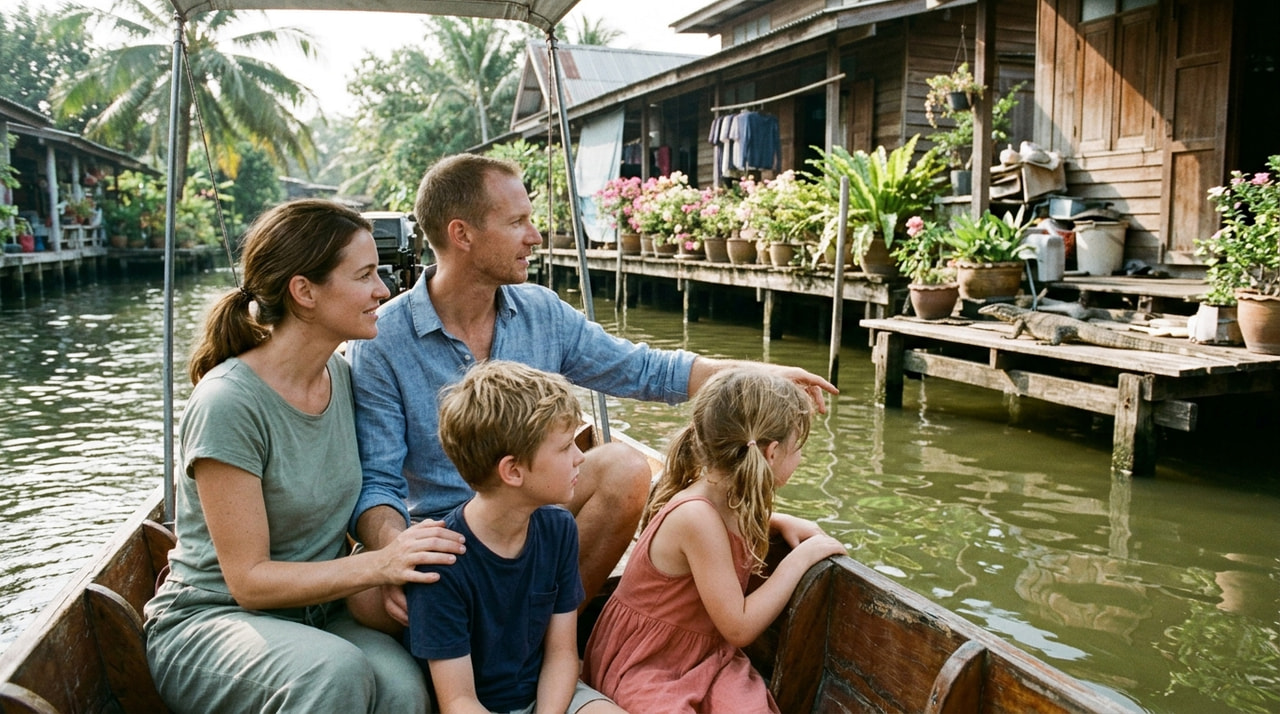
The morning sun has barely touched the yellow shutters along a Hanoi side street, and the pavement is already alive with steam from a pot of simmering chicken broth. A woman sets down two bowls of hot rice noodles and slides small wooden stools forward for two children who have spent ten minutes counting bicycles. There is no tour coach idling nearby and no scramble to pack bags before an early checkout.
This is what a thoughtfully planned vietnam family itinerary looks like when it is built around the natural energy of children rather than an ambitious checklist.
Many packages treat Vietnam as a linear sprint. They trace the long eastern coast on a map and fit five different hotels into fourteen days: two nights in Hanoi, one night on a crowded boat, an overnight train, two nights in Hoi An and a flight south. By the second week, parents have become luggage handlers and children are tired of airports. Nobody remembers the scenery because everyone was too tired to look.
Vietnam rewards families who slow down. Narrow your focus to the north, the central coast and one easy beach, and fourteen days become a journey rather than a transfer schedule.
The two-week dilemma: why less is more
When you plan two weeks in Vietnam with children, you choose between seeing the whole country quickly and seeing a few places properly. Vietnam is long and narrow. Every move between distant regions costs most of a day once you count checkouts, airport transfers, baggage and settling into a new room, and small children feel that cost more than adults do.
A calmer shape looks like this:
- The cultural north (days 1 to 7): Hanoi for a gentle start, the limestone valleys of Ninh Binh, and a night or two on the water in Lan Ha Bay.
- The heritage coast (days 8 to 13): the railway along the Hai Van coast and the lantern lanes of Hoi An.
- A beach finish (day 14 onward, if you have time): Phan Thiet and Mui Ne, for sea and sand after a lot of sightseeing.
That means one main internal flight, and you unpack only a handful of times. Spending three or four consecutive nights in each base gives children a comforting routine, and it gives parents the luxury of lingering over a second cup of coffee.
Families who want to see the whole country from north to south should look at our longer Vietnam Slow Odyssey: Long. For standard school holidays, the shorter Vietnam Slow Odyssey: Short follows the same philosophy of fewer places, held for longer.
Days 1 to 3: gentle beginnings in Hanoi
Arriving in Hanoi after a long flight can overwhelm small children. Motorbikes, street-side charcoal stoves and narrow alleys call for an unhurried introduction.
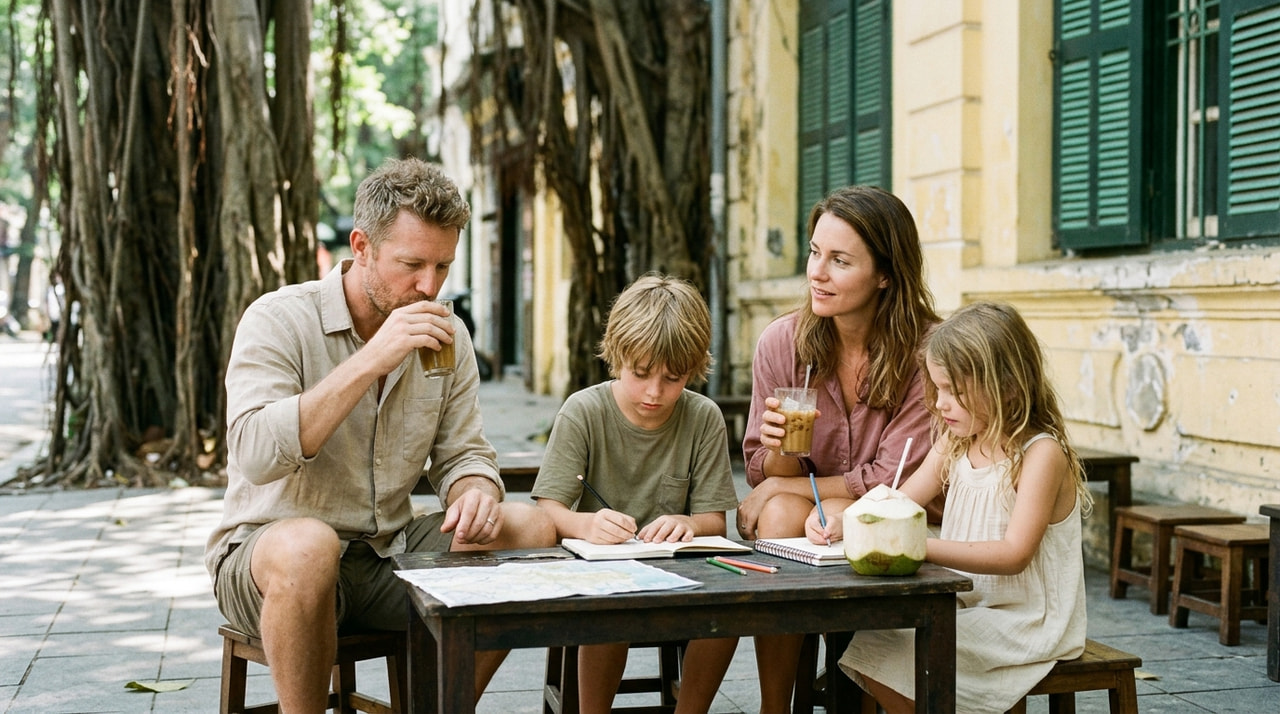
The arrival rhythm
Plan nothing on the first afternoon beyond checking in to a hotel with a family room and a stroll. Hanoi's Hoan Kiem Lake has a path around the water where children can walk without dodging scooters.
Morning exploration, afternoon shade
Structure each day around early energy.
- The Temple of Literature. Wikipedia says the temple was founded in 1070, and that it hosted the Imperial Academy, Vietnam's first national university, from 1076 to 1779. Arrive near opening time, when the courtyards are calm, and let children look for the stone turtles and walk the quiet courtyards.
- Water puppets. Water puppetry is a Vietnamese tradition that, according to Wikipedia, dates back as far as the 11th century and began in the villages of the Red River delta. A show is short and lively, which suits children who cannot sit still for long.
- The Old Quarter by cyclo or on foot. Pavements can be uneven and full of parked motorbikes, so go slowly and hold small hands.
Days 4 to 5: the karst valleys of Ninh Binh
Many visitors see Ninh Binh on a long day trip from Hanoi. Staying two nights is gentler on children and much more rewarding.
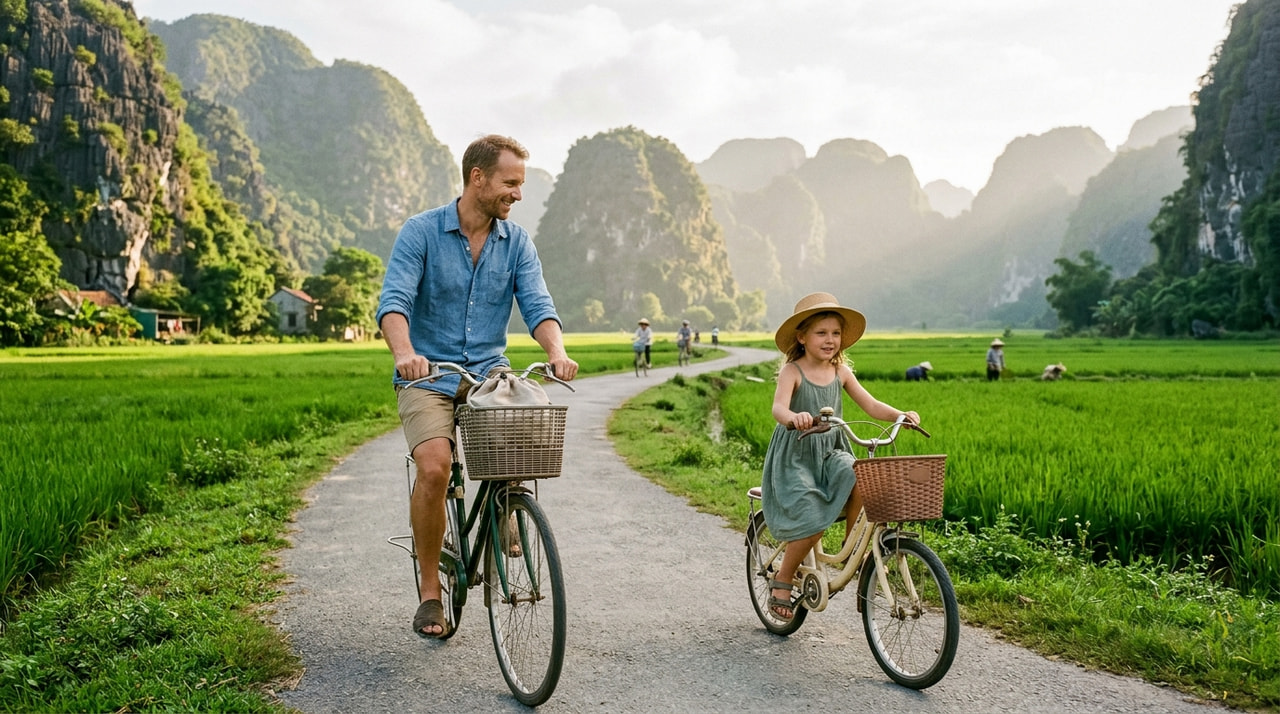
UNESCO describes the Trang An Landscape Complex as a spectacular landscape of limestone karst peaks, with valleys some of which are submerged, framed by steep, almost vertical cliffs. The inscribed area covers 6,226 hectares, and the surrounding buffer zone is mostly rural land with rice paddy fields. For a family, that means boat trips through the valleys and flat, quiet lanes between the paddies.
- Boat trips. Go early, before the crowds, and ask your hotel to arrange it so that you are not queueing at a pier with hungry children. Life jackets should be provided, but check that there are child sizes before you set off.
- Cycling. Quiet village lanes between rice fields suit children on their own bikes or in a seat. Choose the cooler end of the day.
- Sun and water. There is little shade on an open boat. Bring hats, sun protection and plenty of drinking water.
Days 6 to 7: Lan Ha Bay and Halong Bay
Halong Bay is a UNESCO World Heritage Site. Wikipedia describes thousands of limestone karsts and islets, an area of around 1,553 square kilometres including 1,969 islets, and says Lan Ha Bay borders it to the south and southeast. The same article notes the similar landscape and geology across Ha Long Bay, the Cat Ba archipelago and Bai Tu Long Bay.
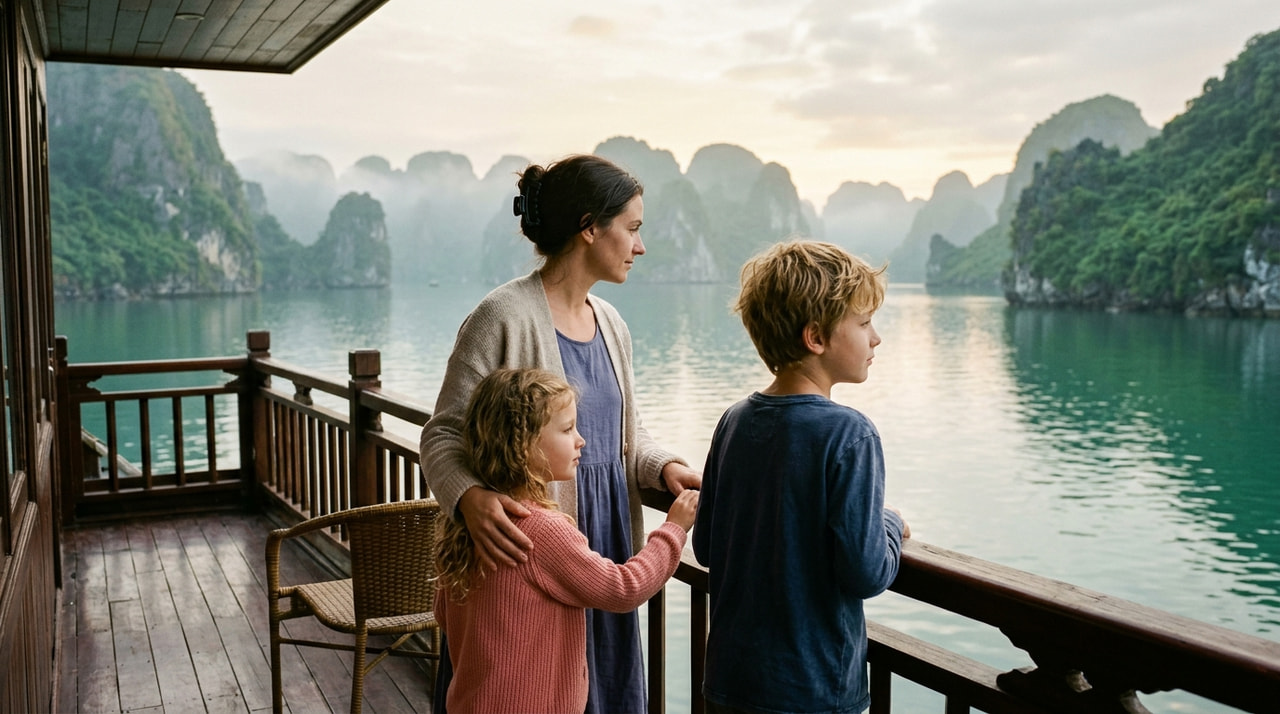
Because the two bays are so alike, the sensible way to choose is to ask questions rather than trust a slogan:
- Where will the boat anchor, and how many other boats are there in my month?
- How many nights? A single night on a boat can mean mostly boarding and checkout. Two nights leave a full day on the water.
- Is there a swimming stop and a kayak stop suitable for small children? Ask whether life jackets in child sizes are provided.
- How do cabins work for a family? Connecting rooms or a family suite make bedtime easier.
Day 8: the Hai Van coast by train
After the bay, a short flight takes you south to Da Nang. If your schedule allows a gentler detour through the imperial city of Hue, take the coastal train south.
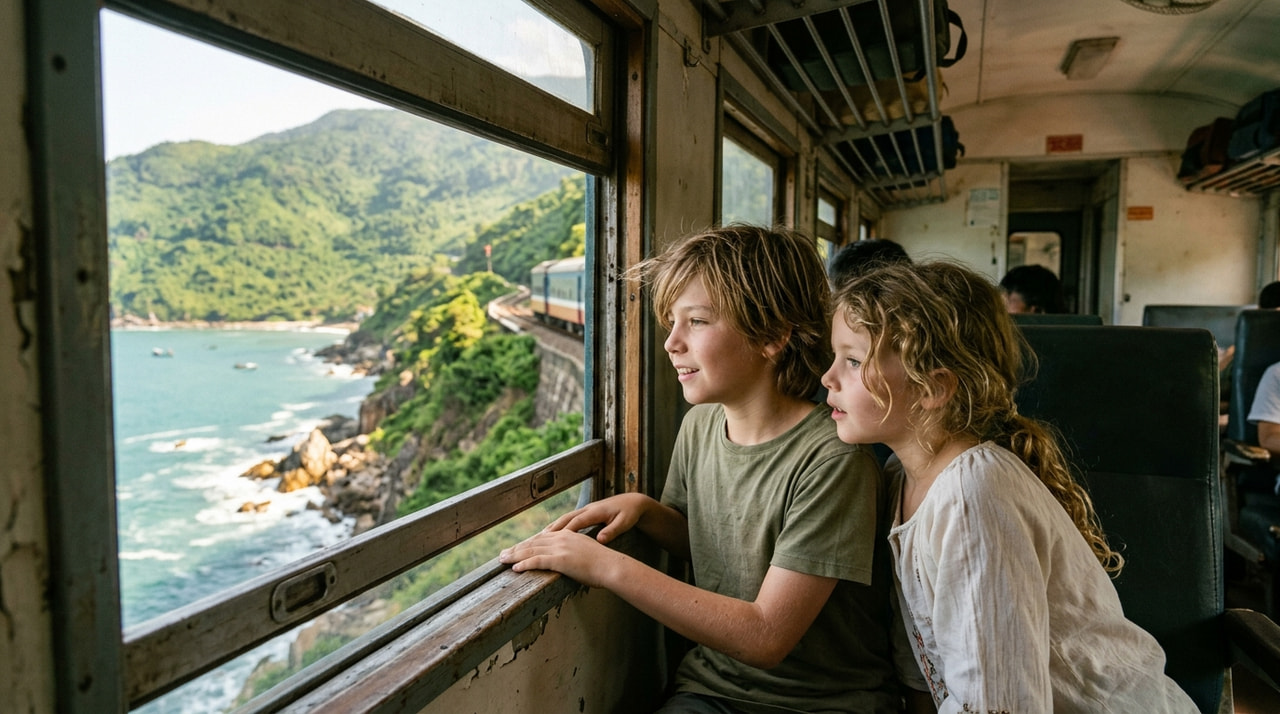
Wikipedia notes that the Hai Van Pass is crossed by two routes: National Route 1, which uses the Hai Van Tunnel (the longest tunnel in Southeast Asia), and the North–South Railway, which hugs the coastline and passes through a series of tunnels. For a family, a daytime coastal leg beats an overnight sleeper: children see the sea, stretch their legs and eat at normal times. Check current timetables and which seats face the sea before you book.
Days 9 to 13: Hoi An and the coast
Hoi An is the emotional heart of an unhurried Vietnam trip. UNESCO calls the Ancient Town an exceptionally well-preserved example of a South-East Asian trading port, active from the 15th to the 19th century.
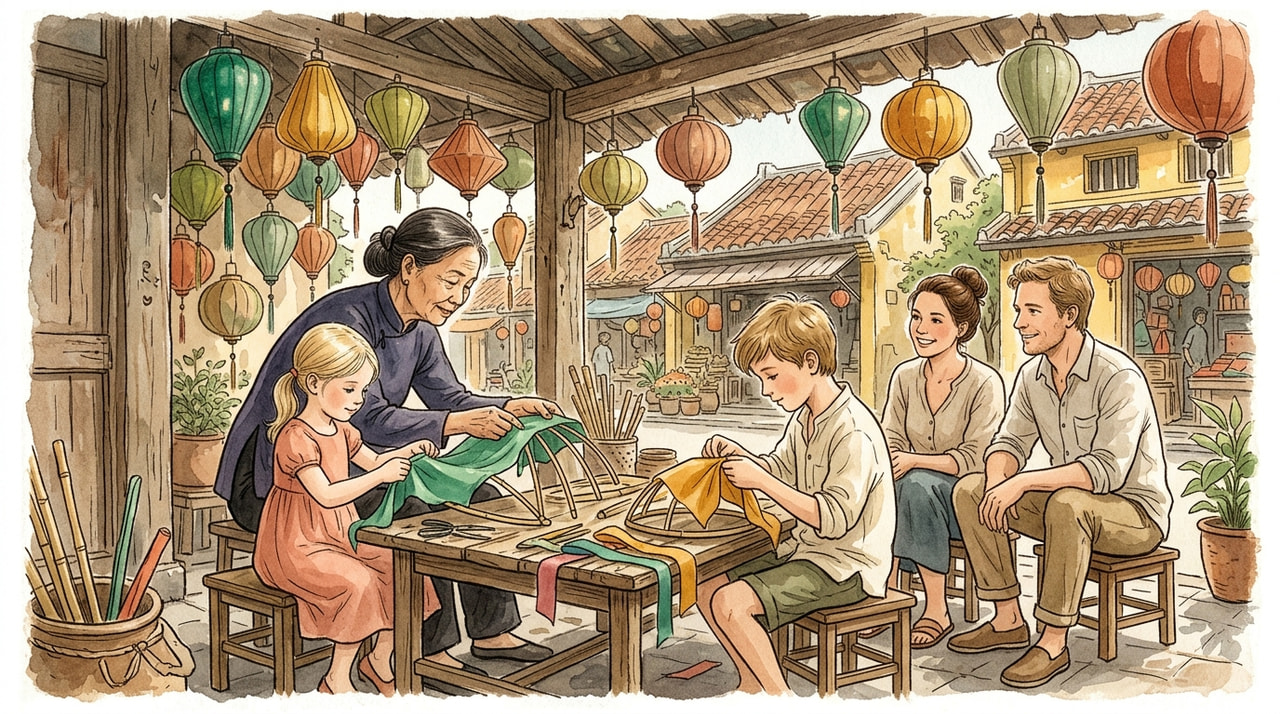
Many travellers stay two nights and rush the town. Four or five nights allow a settled rhythm of cultural mornings, a rest at midday and time by the sea.
- The Ancient Town in the cool hours. Walk early or in the evening, when the lanterns come on.
- Hands-on afternoons. Look for family-friendly workshops such as lantern making. They give children something to do with their hands during the heat of the day.
- The beach. The coast is a short ride from the town. Ask your hotel about swimming conditions on the day, and use the flags and lifeguards where there are any.
A beach finish: Phan Thiet and Mui Ne
If you have a few extra days, or the energy for one more move, finish at the sea. We found Phan Thiet and Mui Ne great with small children on a trip around 2025.
Mui Ne and the other wards of Phan Thiet stretch along the coast for roughly 50 kilometres, and, according to Wikipedia, became a resort destination from the mid-1990s. The article lists the Red and White Sand Dunes, Fairy Stream and Mui Ne Beach as the main attractions, and describes Ham Tien Beach as a quieter beach with beachfront resorts.
For families with small children, a beach resort at the end of a trip does two jobs. It gives children a swim and sandcastles after days of sightseeing, and it lets everyone rest before the flight home. Choose a hotel with a pool and a kids' club if you can, and keep the sand dunes for the cool early morning.
Eating well without red meat
Vietnamese food works well for families who avoid beef and pork. Chicken, egg, seafood and vegetable dishes are easy to find, and children can eat plain rice or noodles alongside them.
Written phrases help. Keep these on your phone:
- "Không thịt heo, không thịt bò" (no pork, no beef).
- "Tôi ăn chay" (I eat vegetarian).
- "Xin đừng cho ớt cay" (please, no spicy chilli).
For a treat, children usually love sinh tố xoài, a fresh mango smoothie.
Practical planning: visa, season and health
Visa
According to Wikipedia, from 15 August 2023 an e-Visa is issued to citizens of all countries and territories, for single or multiple entry up to 90 days, at 25 US dollars for single entry or 50 for multiple. Fees and rules change, so apply through the official government portal and confirm the current terms there. Avoid agents who add large markups for the same application. Check that every passport has enough validity remaining and blank pages.
Season
Wikipedia explains that the north has four seasons, with a humid subtropical, monsoonal climate, while the south and the centre have a tropical monsoon climate with just two: rainy and dry. It adds that Vietnam sees six to eight typhoons or tropical cyclones a year on average. In practice, that means checking the season for each region you plan to visit and not assuming one forecast fits the country.
Health
The CDC lists dengue, which spreads by insect bites and cannot be prevented with a vaccine, among the diseases in Vietnam, and advises safe food and water habits. In practice, use bottled or treated water for drinking and brushing teeth, protect children from mosquito bites, and talk to your doctor about vaccines and insurance before you travel. Find out where the nearest hospital with an English-speaking paediatrician is for each base before you arrive.
Close with a next step
A good family holiday is not measured by the number of pins on a map. What matters is how connected and rested everyone feels at the end of it. By focusing on a few complementary places and protecting your daily rhythm, Vietnam becomes an unhurried adventure your children will talk about for years.
When you are ready to have a journey curated and managed end to end, explore our Vietnam Slow Odyssey: Short and the longer Vietnam Slow Odyssey: Long.