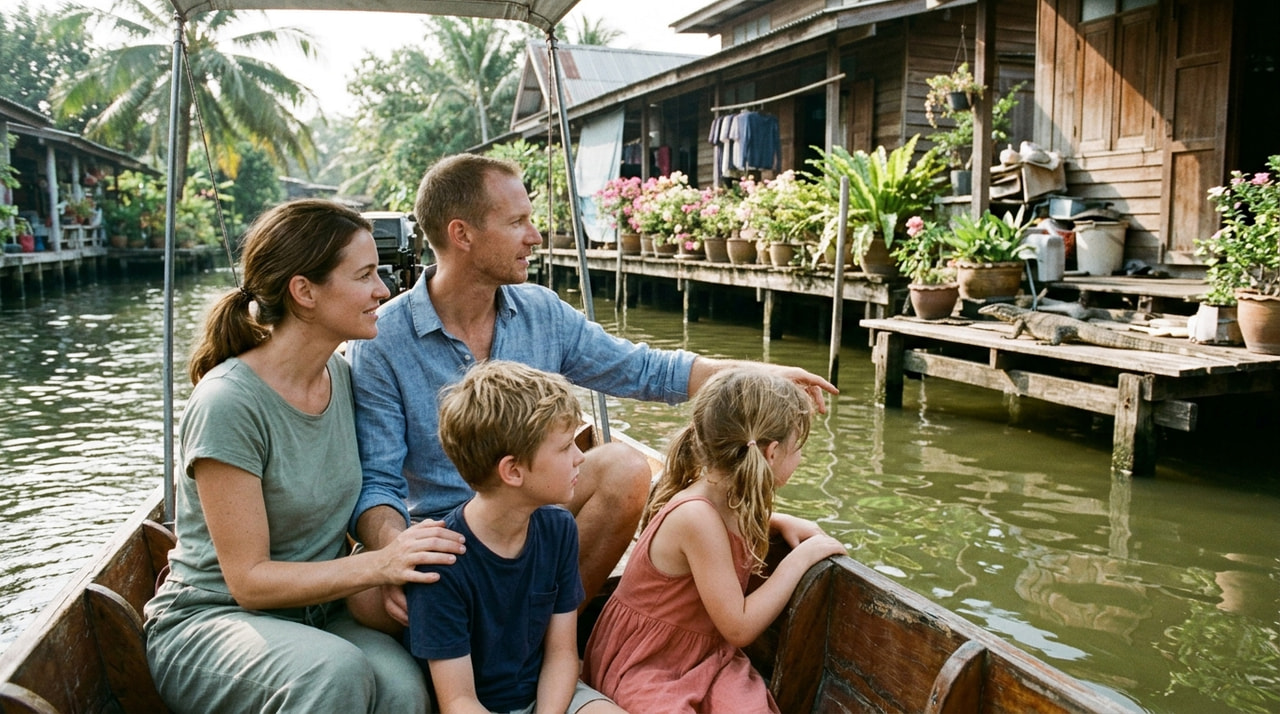
The boat has no engine noise to speak of. A pole pushes it along a narrow canal, and coconut palms lean over the water on both sides. A girl trails her fingers over the side and a boy counts kingfishers. Nobody has said a word for a few minutes, and nobody needed to.
This is the Kerala most families hope for. It takes a little planning, because the usual brochure image of an overnight houseboat is not the only way to see the backwaters, and may not be the best way for small children.
The backwaters: houseboat or day boat?
Wikipedia describes the Kerala backwaters as a network of brackish lagoons and canals running parallel to the Arabian Sea along the Malabar Coast. Vembanad, at 2,033 square kilometres, is Kerala's largest lake, and the kettuvallam, the Kerala houseboat, is one of the state's prominent tourist attractions.
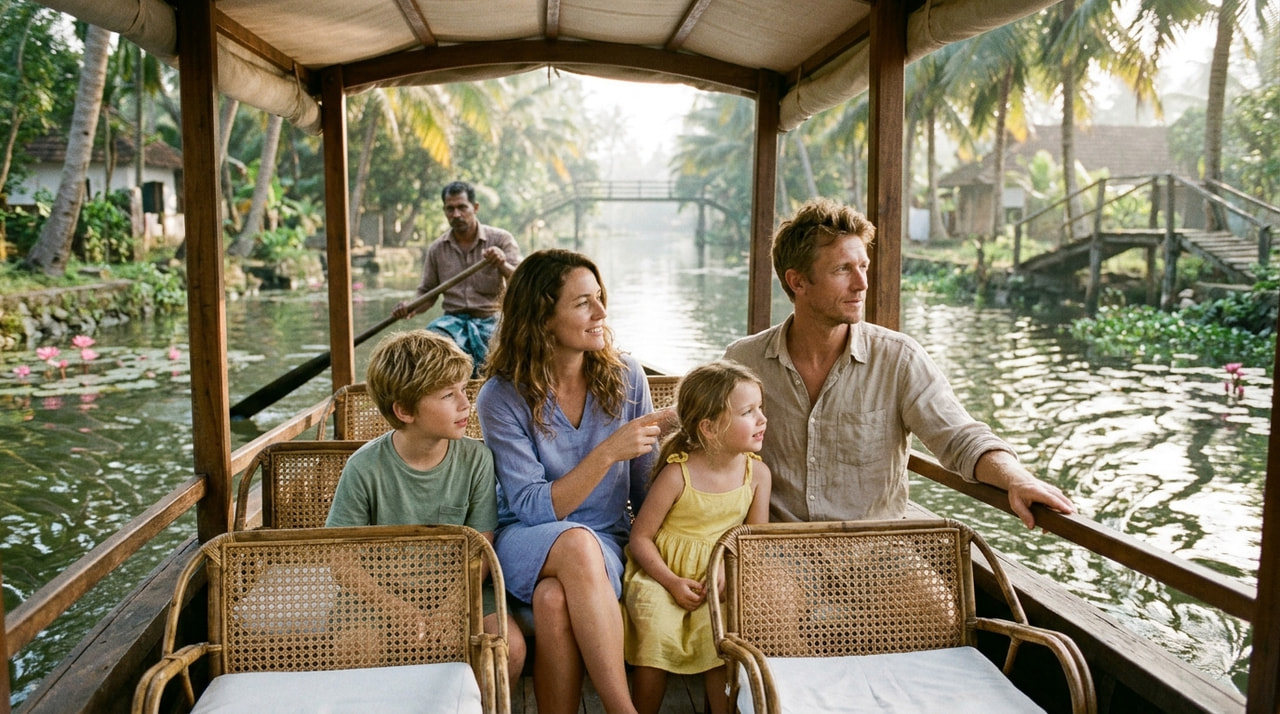
For families, the choice is practical.
- An overnight houseboat is a memorable idea, and many families love it. With toddlers, think about open railings, water on every side, a night on a boat and how your children sleep somewhere new.
- A daytime boat keeps the best part, the canals and the village life, and gives you a normal bedtime on land.
Our advice is to start with a daytime trip. You will see how your children take to being on the water, and you can decide about a night afterwards. Whichever you choose, ask for child-sized life jackets and agree the route and price before you set off.
A balanced ten-day route
A calm route has four bases and few long drives.
- Fort Kochi (days 1 to 2): heritage lanes and the fishing nets.
- Munnar (days 3 to 5): the tea hills.
- Kumarakom (days 6 to 7): the backwaters at a slow pace.
- A beach (days 8 to 10): time to do very little.
For a journey planned end to end around this rhythm, see our Kerala Unhurried expedition.
Fort Kochi (days 1 to 2)
Wikipedia says Fort Kochi takes its name from Fort Manuel of Kochi, the first European fort on Indian soil, and is known for its heritage and culture.
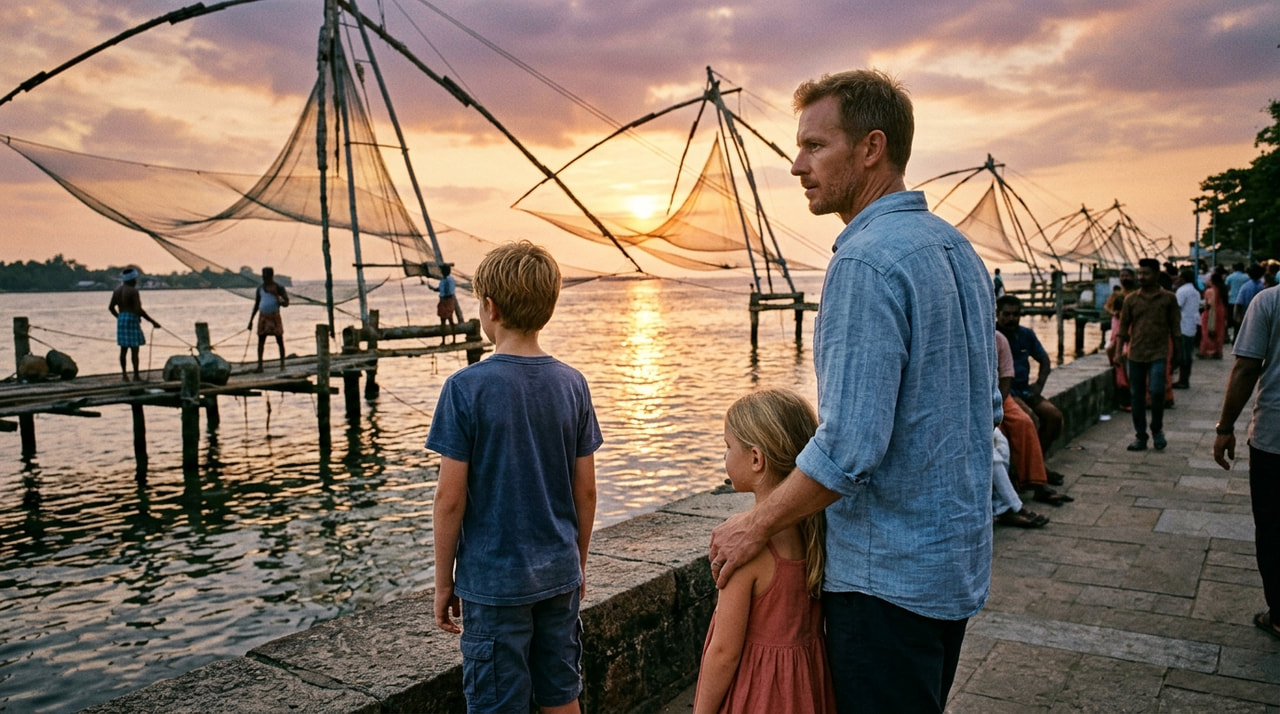
The Chinese fishing nets are a good first stop for children. Wikipedia describes them as stationary lift nets, each structure at least 10 metres high, a cantilever with an outstretched net over the sea and large stones hung from ropes as counterweights. Children enjoy watching the net go down and come up. Go in the late afternoon, when it is cooler, and keep small hands away from the water's edge.
Munnar (days 3 to 5)
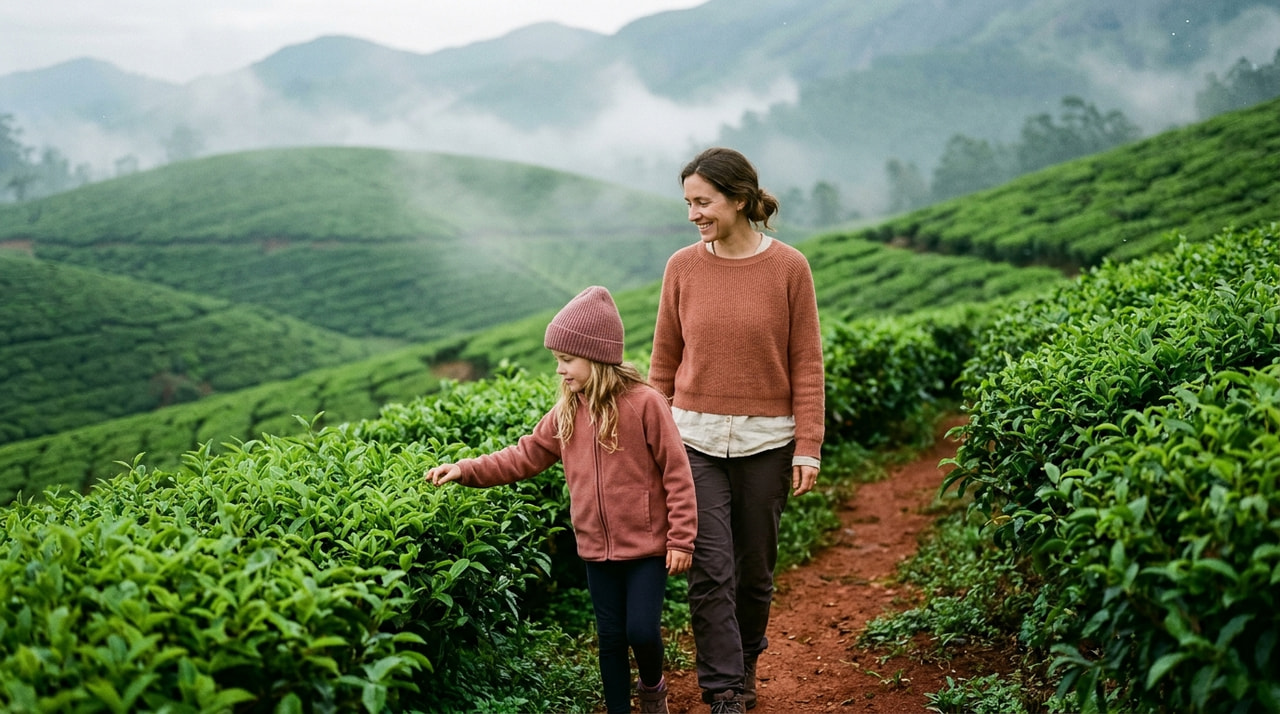
Wikipedia says Munnar sits at around 1,600 metres above sea level in the Western Ghats, and is dominated by its tea industry. That means cool air and green hills after the heat of the coast.
Managing the climb
The road up to the hills is winding, and small children can feel it. Leave early, break the drive with a stop, and keep snacks and water within reach. Give yourselves three nights, so the climb is worth it and the children can settle into the mountain pace.
Unhurried days
- Tea garden walks. Go in the cool morning, in comfortable shoes.
- Eravikulam National Park. Wikipedia says the park has the largest regional population of the Nilgiri tahr, a rare highland ungulate, estimated at 750 individuals. Check the park's opening dates and booking rules before you plan around it.
- A quiet afternoon. Cooler air makes a good nap time.
Kumarakom (days 6 to 7)
Kerala Tourism describes Kumarakom as a cluster of little islands on Vembanad Lake, part of the Kuttanad region, with a labyrinth of backwaters and mangrove forests all around it. Incredible India says the backwaters of Kumarakom, a network of canals, lakes and lagoons, are its most prominent attraction, and that the area was once a vital trading hub.
For families, this is the place to slow down. A short boat trip in the morning, a long lunch and an afternoon by a pool suit small children far better than a full day of touring.
- Choose the stay with children in mind. Ask about lawns, shade, water edges and the depth of the pool.
- Keep boat trips short. An hour or two on the water is plenty, and the children will remember it more happily.
- Plan the evenings. Mosquitoes are more active at dusk, so cover arms and legs and use repellent that is suitable for children.
A beach finish
Wikipedia lists Marari Beach, reached from Mararikulam, which has its own railway station, in Alappuzha district. After a week of sightseeing, a beach is the place to do nothing. Check swimming conditions and flags on the day, and watch small children closely near the water. We will add photos and more detail to this section.
Eating well without red meat
Kerala cooking offers plenty for families who avoid beef and pork.
- Appam. Wikipedia says it is made with fermented rice batter and coconut milk, traditionally cooked in a deep pan like a wok, and is most often served for breakfast or dinner with a side such as a vegetable or egg curry.
- Sadya. Wikipedia describes it as a feast of traditional vegetarian dishes, usually served on a banana leaf at lunch, for festivals such as Onam and Vishu and special occasions.
- Fish, chicken and eggs. Easy to find. Ask for dishes with less chilli for small children and keep spicy sauces on the side.
If anyone in the family has a food allergy, talk to your doctor before you travel and carry a translation card.
Health and planning
The CDC recommends that travellers going to certain areas of India take prescription medicine to prevent malaria, and lists dengue, Zika and filariasis among diseases spread by insects that a vaccine cannot prevent. It also advises safe food and water habits, including washing hands at key times. Talk to your doctor about your route and your children's vaccines, use child-suitable repellent, drink bottled or treated water, and find out where the nearest hospital is for each base.
How to pace the days
Small children do best with a rhythm. In Kerala's heat, that means doing the main outing in the morning, resting through the middle of the day, and keeping the evening for something short and close to where you are staying.
- Mornings: boats, walks and visits, while it is cooler and everyone is fresh.
- Middle of the day: food, a swim and a rest. A child who naps will do better with a proper break at the hotel.
- Evenings: a short walk, an early dinner and an early night. Long journeys late in the afternoon are where tempers fray.
- Moving between bases: keep each drive short, pack snacks and water, and travel at the time your children are usually calmest.
A slower trip also means fewer things to book. Choose a base, learn the area, and let one or two good experiences stand in for a long list.
Close with a next step
Kerala is at its best when you leave room for it. A day boat, a cool hill, a long breakfast and a quiet beach are enough. If you would like help turning this route into a journey planned from home to home, explore our Kerala Unhurried expedition.