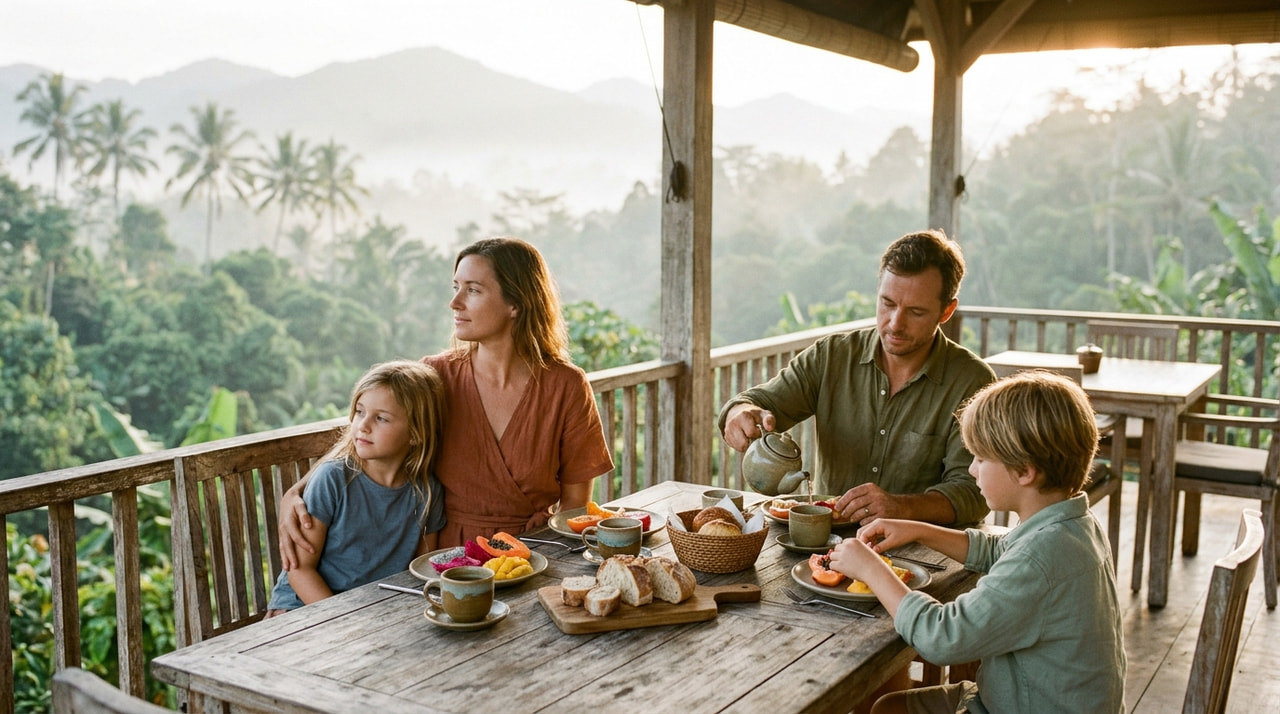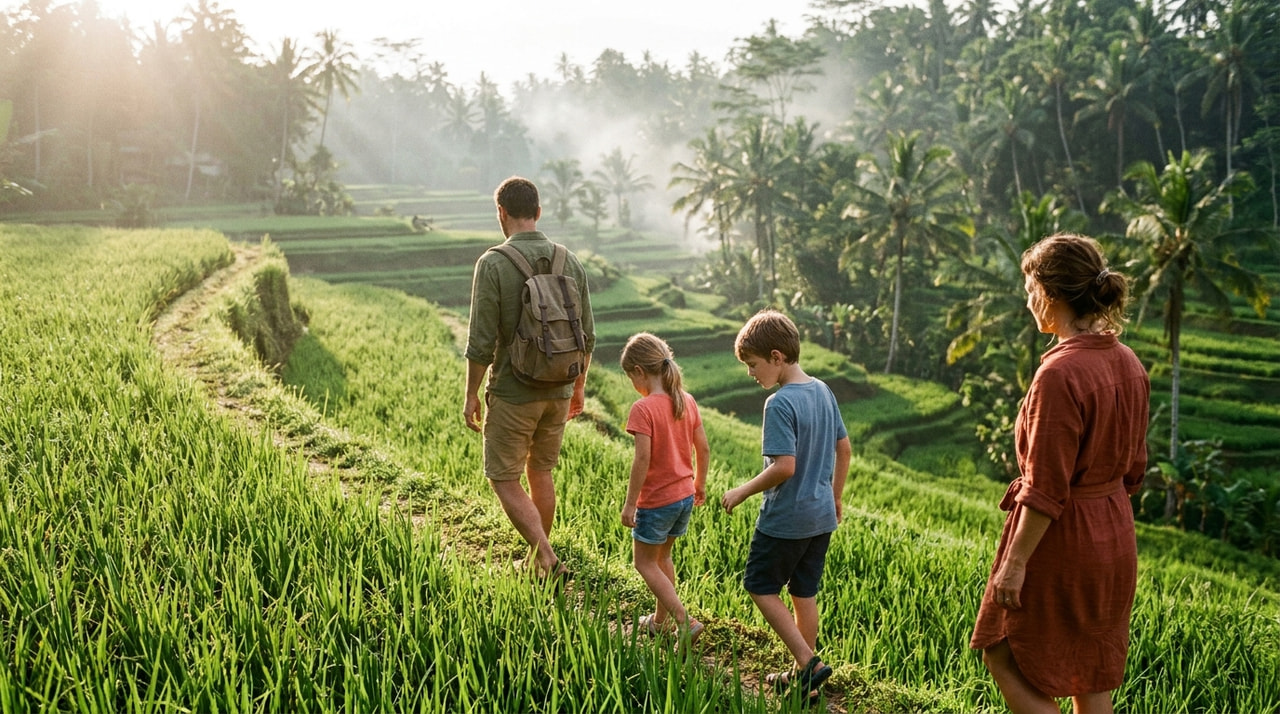

Your eight-year-old has been asking since you mentioned the idea. The five-year-old, who still needs a quiet hour after lunch most days, has decided on the strength of one photograph that she is coming too. Parents planning Bali with kids usually wonder whether an island known for surf breaks and cliff-top bars has room for a family moving at a family's pace. It does. The real questions are which part to pick, how long to stay, and what to sort out before you land.
Which part of Bali to base yourself in
Bali is not one place. The south is loud, gridlocked and spectacular in the way of somewhere that knows it is famous. The highlands are cooler, quieter and richer in culture. Getting this wrong on a first trip costs days and goodwill.
For families, the most reliable combination is four nights in Ubud followed by five on the coast. On the coast, Sanur is the choice if your children are under ten or eleven.
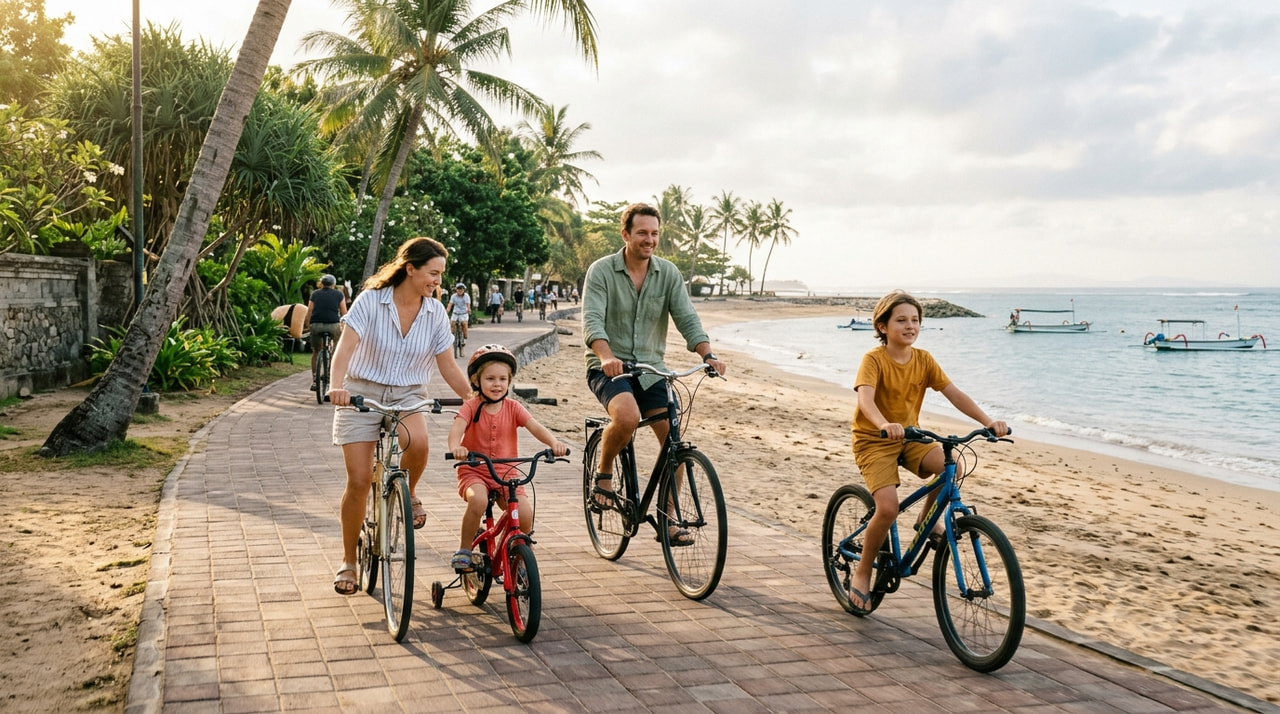
Sanur sits behind a coral reef. The lagoon between the beach and the reef is shallow and calm, without the shore-break and undertow you meet at the open surf beaches of Seminyak and Kuta, where small swimmers need close watching. A paved path runs along the sand for about five kilometres (guides put it anywhere from four to seven), flat and wide enough for a stroller or a child on a bike with training wheels. The streets behind it are calmer than Seminyak's, and Bali International Hospital is in Sanur itself, which is a comfort with small children.
Kuta is the other coast option, and it was our favourite base last year. We stayed in Kuta at Four Points by Sheraton Bali and at YELLO Hotel Kuta, at Beachwalk, and the hotel kids' club did a lot of work for us, with the beach close enough to walk to. Kuta is well connected, so full-day trips were easy to run from one hotel without changing base. In the evenings we roamed the old street and the food street on foot with the children. On some other parts of the island we stayed, lizards were everywhere in the rooms and grounds; Kuta was better on that. The trade-offs are real. The main shopping street has heavy traffic, and the small walking lanes behind it share space with motorbikes, so hold small hands. The sea is a different matter from Sanur's. Kuta is an open surf beach, and strong undercurrents can run on days when the waves look low: a 2019 Jakarta Post report described five children swept away at Kuta on a day when the waves were not high, and said lifeguards rescued them. Swim between the lifeguard flags, keep children close to the shore, and let the younger ones play at the water's edge rather than in the surf. That makes Kuta a good fit for families who want the hotel and day-trip convenience, and are comfortable supervising closely at the beach.
Nusa Dua suits you if you want the full resort experience. Many of its resorts run kids' clubs and babysitting, which can give parents a couple of quiet hours. It costs more and feels further from everyday Balinese life, which matters or not depending on what you came for.
Ubud is not a beach destination. The coast is well over an hour away, and longer in afternoon traffic. What it offers is cooler evenings, rice terraces, crafts, gardens and cooking classes. It suits children of seven and over, who can walk some distance, pay attention and form opinions. The streets in central Ubud are narrow and busy, so a stroller is awkward.
Seminyak and Canggu are the wrong bases for a first trip with young children. The surf is strong, the roads are crowded, and the pavements are thin. Both are built around surf culture and beach clubs. They work for teenagers and for families who already know Bali.
How long to stay
Most family-travel guides land on eight to ten nights for a first trip. Seven nights works, but you would choose Ubud or the coast rather than both, and the contrast between them is what makes Bali work for a whole family.
Ten nights suits a family that travels slowly: three to four in Ubud, four to five on the coast, and one or two days with no plan. Those empty days are not wasted. A morning at the pool with nowhere to be, an afternoon in a cafe while the children draw, a wander through a market: these are what families remember, and they make the busy days feel full instead of relentless.
With fourteen nights or more there is room for a boat trip to Nusa Lembongan, a small island reached by fast boat from Sanur. It is a nice extra for children who can manage a boat and a snorkel, and it is not needed on a first visit.
When to go
Bali has a dry season (roughly April to October) and a wet one (roughly November to March). The most dependable weather comes from May to September, with sunshine on most days and lower humidity.
July and August bring the best weather and also the highest prices, full resorts and slow roads in the south. If you travel then, book early.
The sweet spot for a first family trip is May, June or September. The weather is good, the busiest places are quieter than in midsummer, and prices sit below the July peak. April is the tail of the wet season: the land is green and an afternoon downpour is still possible, so keep your afternoons flexible. December is the hardest month for first-timers, with peak prices, rain and heavy traffic around Seminyak and Kuta.
Paperwork to sort before you leave
Most nationalities need a visa to enter Indonesia. The simplest route for families is the e-VOA (electronic visa on arrival), applied for online at the official immigration portal before you fly. The fee is IDR 500,000 per person, children included, and every child needs their own. The government has said it plans to raise this fee, so check the portal for the current amount.
Applying in advance means you arrive with the paperwork done. It is a better start than sorting it out in a queue after a long flight.
Bali also charges a tourist levy, IDR 150,000 per person, with no discount for children. It is paid online through the Bali provincial government's official site, which is simpler than doing it at the airport.
A third step: Indonesia asks every international arrival to complete the free All Indonesia arrival card online, within 72 hours before arrival. Use only the official government address. Sites that charge a fee for the card are not official.
What children eat in Bali
The fear that children will refuse everything and live on plain rice is usually misplaced. Balinese food happens to suit children well: the heat is usually in the sambal, and the sambal arrives in its own small bowl. Order nasi goreng (fried rice) or mie goreng (fried noodles) and the dish comes mild and savoury. Children eat what everyone else eats, minus the heat, and adults add sambal to taste.
If your family eats chicken: sate ayam (chicken satay) is the safest bet. The marinade is sweet soy sauce with turmeric and garlic, and it comes with peanut sauce. Almost every restaurant serves it, from a roadside warung to a resort kitchen. Ayam goreng (fried chicken) is the other dependable choice. For either, ask for the sambal on the side.
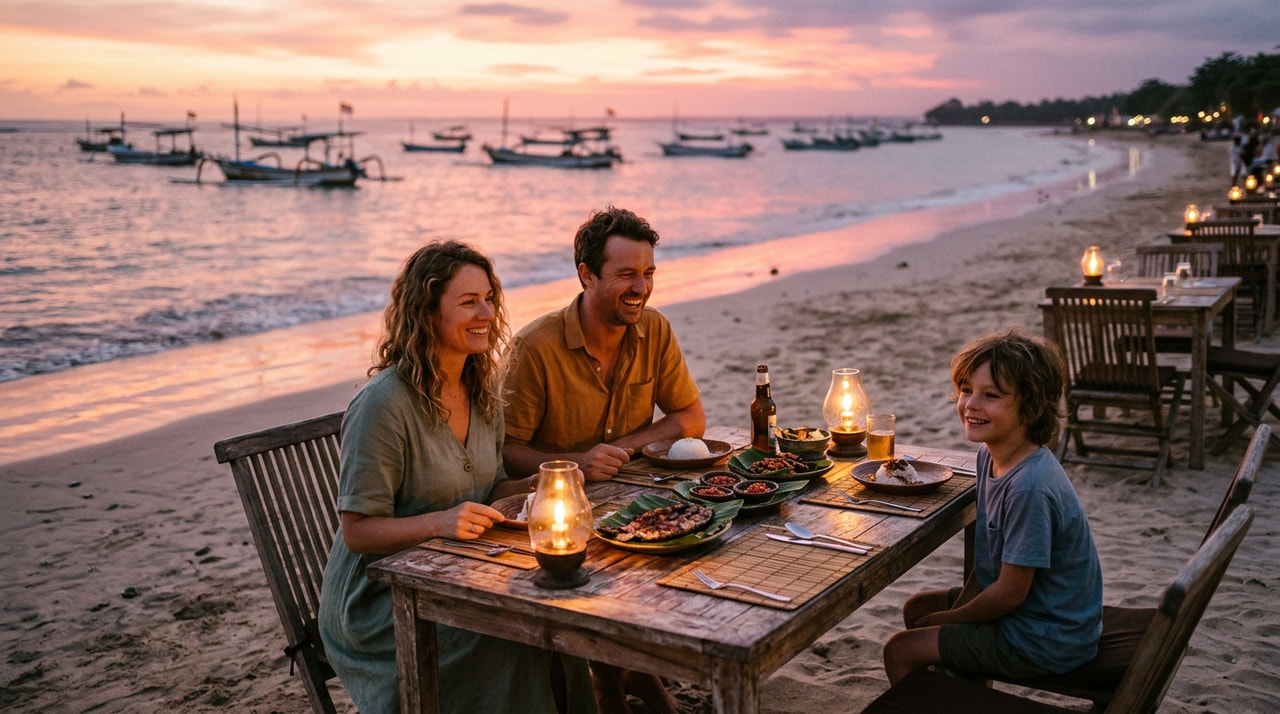
If your family eats seafood: the beach grills at Jimbaran Bay are the classic family dinner. A row of open-air cafes sets tables on the sand, and fish and prawns are grilled over coconut husk charcoal. At Menega Cafe, one of the best known along the strip, you choose your seafood at the front before it is grilled. Children can play on the sand while you wait, which helps with a long dinner. For children under eight, ask for fillets rather than a whole fish, because whole grilled snapper has fine bones.
For meals without meat: Ubud is known for plant-based cafes. Moksa, in Sayan just outside town, grows much of its produce in its own permaculture garden, though it is a quieter, more grown-up place, so ask about high chairs and children's portions before you go. Alchemy, a raw vegan cafe in Penestanan, has a salad bar that suits children who like to choose their own plate. Tofu and tempeh are common in traditional Balinese dishes, in many forms.
One note for families who avoid shellfish: terasi, a fermented shrimp paste, is a common base in Balinese cooking, including in some sambals and vegetable dishes that might otherwise look vegetarian. Ask for your dish tanpa terasi, which means without shrimp paste.


The health concern most guides understate
Traveller's diarrhoea, known locally as Bali Belly, is well known and simple to prevent. Do not drink tap water, including when brushing teeth. Ice at established restaurants is usually made from purified water, but ask, and skip it at roadside stalls. Skip raw salads that may have been washed in tap water. Fruit you peel yourself, such as bananas, papaya and mango, is dependable.
Dengue is less discussed, and for families with children it is the more important thing to understand before you go. It is a year-round risk in Bali, not only a wet-season one. The mosquitoes that carry it bite in daylight, mostly in the morning and the hour before dusk, not at night. Bali's health office counted around 15,000 cases in 2024 and about 10,400 in 2025, and the regencies of Badung (the south coast) and Gianyar (Ubud) are regularly among the hardest hit.
The US Centers for Disease Control recommends repellent containing DEET or picaridin on exposed skin. Follow the label for children and ask your paediatrician about your child's age. Do not use repellent on babies under two months; use netting over carriers and strollers instead. Apply it each morning, and again after swimming. Light long sleeves at dusk help. Check that your room has screens or working air conditioning.
Dengue symptoms usually appear within four to ten days of a bite: sudden high fever, a strong headache, pain behind the eyes and aching muscles. If a child develops these after a trip, see a doctor promptly and say where you have been. On the island, Bali International Hospital in Sanur, and the BIMC and Siloam hospitals in Kuta and Nusa Dua, run 24-hour emergency departments. Check that your travel insurance covers medical evacuation as well as local hospital bills.
One more thing to check before you book a private villa: pool fences. Many villa pools in Bali have none, which is a real hazard with toddlers. Confirm the arrangement before you arrive, not when you are standing at the pool at nine in the evening with a two-year-old.
Two things that are not a temple and not a beach
By day four or five, most families are ready for something that is neither a sarong-and-sandals temple visit nor another swim. These two suit children well.
The Bali Treetop Adventure Park sits in the botanical garden at Bedugul, a highland lake town north of Ubud. It has rope circuits and ziplines in the forest canopy, with easier circuits for young children. Its own rules are set circuit by circuit, with a minimum age of about 4 and a minimum height of 95 cm for the youngest circuit, so check before you book. The air up there is cooler than on the coast, and the drive through the highlands is part of the day.
The Bali Butterfly Park in Tabanan is a netted garden where staff will help place butterflies (and some moths) gently on visitors' hands. Children between three and ten are usually the most delighted. It is quiet and rarely crowded, a different pace from anywhere else on the island.
If your plans include Ubud's Monkey Forest, know this first. Rabies exists in Bali. Officials describe the risk at well-run sites as low, but a bite or scratch from any monkey should be treated like a dog bite: wash the wound with soap and running water, and get medical advice the same day. Do not rely on first-aid reassurance alone. For the under-eights, the butterfly park is the easier morning.
At the temples: what families need to know
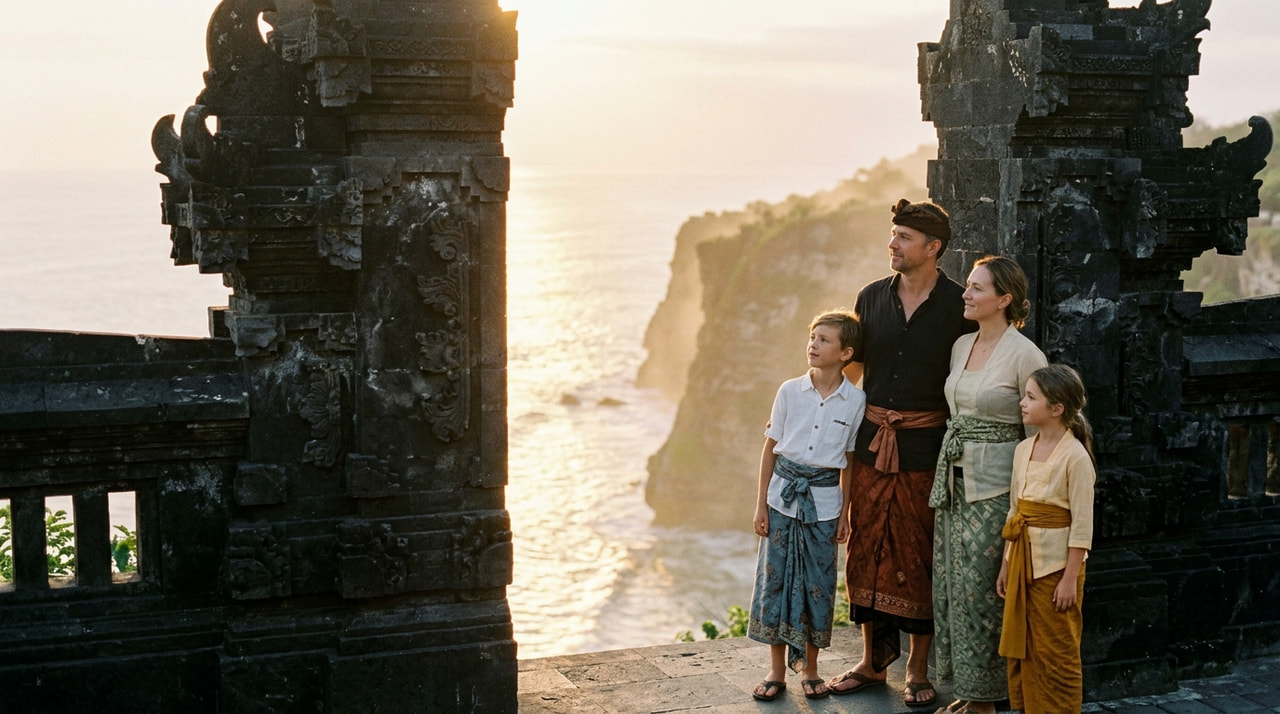
Temples in Bali are places of worship, and entry depends on dress. This applies to children as well as adults from about the age of five. Everyone entering wears a sarong (kamen) and a sash (selendang). Long trousers do not replace the sarong, which is a religious requirement. At Uluwatu, entry is about IDR 50,000 for adults and IDR 30,000 for children aged 6 to 12, and a sarong and sash are included. At Tanah Lot, entry is IDR 75,000 for adults and IDR 40,000 for children aged 5 to 10, and children under five are free. For several temples, light children's sarongs from a local market can save time at the gate.
Shoes come off in the inner courtyards, so slip-ons save time when you are managing two or three children.
The Kecak fire dance at Uluwatu runs in the evening, from about 6pm, and is one of the most memorable things families do on the island: an open-air amphitheatre on a cliff edge, the sea far below, and a chorus of men chanting in firelight. The dance ticket is separate from temple entry, at about IDR 150,000 for adults and IDR 75,000 for children aged 4 to 9. Arrive early for good seats. Some cliff edges at Uluwatu have no guardrails, and the macaques there are bold and quick, so keep glasses, hats, phones and snacks tucked away.
Tanah Lot, the sea temple on a tidal rock, cannot be entered by non-Hindu visitors. The visit is about the approach, the coastal walk and the view. At low tide you can walk across wet rocks toward its base, so wear sandals rather than trainers. The light at dusk is lovely for photographs.
Planning the rest of your trip
Bali is a good first step into slow family travel in Asia. Our Bali Reimagined expedition is built differently from the first-timer route above. It heads for the volcanic highlands, rice terraces and artisan villages, keeps the congested southern beach strips out of the plan, and leaves plenty of unscripted family rest. If the rhythm appeals, what we mean by unhurried explains how we shape each day, and the same shape carries to Vietnam, Malaysia and our other journeys. The day stays the same wherever you are: a rested morning, the best experience before the afternoon dip, a pause, and an evening with room in it.